
Why Study in Malaysia? A Comparison for Bangladeshi Students

The Appeal of Studying Abroad: Goals and Considerations
Every year, thousands of Bangladeshi students plan to study abroad for two reasons: a globally accepted degree and a stronger career trajectory. For many, “study abroad” also quietly means “settle abroad,” which is why the UK, USA, Canada, Australia, and Germany dominate the conversation. These countries offer some mix of part-time work, post-study visas, and possible permanent residency pathways.
So why Malaysia?
This guide answers that by comparing Malaysia with the UK, USA, Canada, Australia, and Germany on education quality, recognition, total cost, work rights, post-study options, lifestyle, proximity, and the visa process. Malaysia is not perfect, but it can be a smart choice, especially if you want international education without the Western price tag.
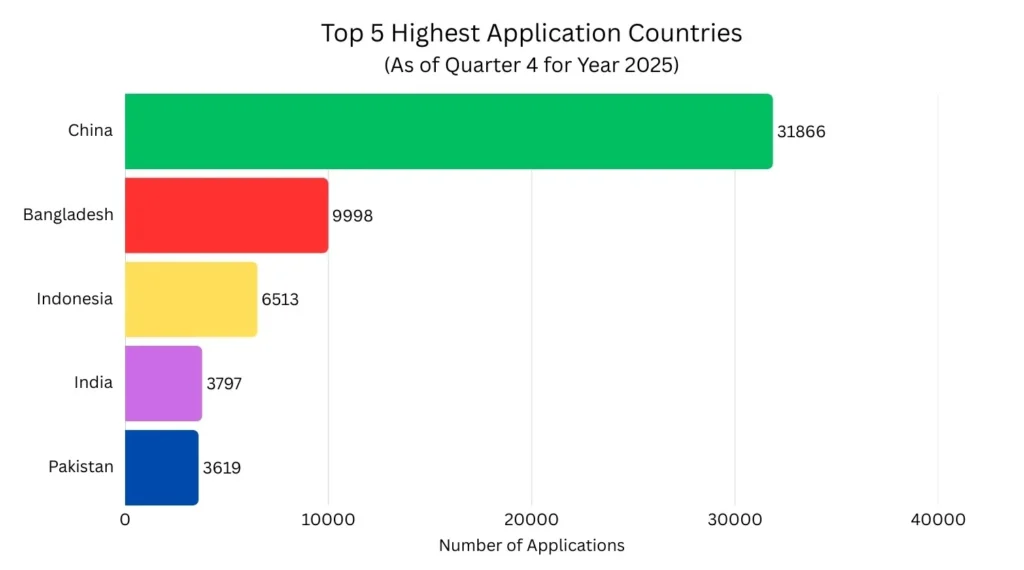
Bangladesh has been the 2nd highest source country for Malaysia for the last few years.
Source: EMGS
Quality of Education and Global Recognition
A common worry is, “Will my degree be respected worldwide?” The UK and USA lead the global prestige race, and Canada, Australia, and Germany also have strong reputations. Malaysia’s strength is twofold: improving local universities and the “best of both worlds” option of branch campuses.
Rapidly Improving Standards: Malaysia has invested heavily in higher education, and several universities now rank among the world’s top 200. University of Malaya, Universiti Putra Malaysia, and Universiti Kebangsaan Malaysia are frequently cited among the strongest names. For students, that means the “Malaysia degree” label is far more recognized today than it was a decade ago, especially if you choose reputable institutions.
International Branch Campuses: Malaysia’s biggest differentiator is foreign branch campuses. You can earn the same degree from universities like the University of Nottingham (UK) or Monash University (Australia) while studying in Malaysia. In many cases, the curriculum, assessments, and degree qualification match the main campus, and some programs support exchanges for a semester or a year. This gives you global brand recognition and international exposure, without paying full Western-campus costs.
Accreditation and Industry Relevance: Malaysia’s Ministry of Higher Education maintains quality assurance, and many programs (especially engineering, business, and health-related fields) align with international standards and professional accreditation routes. A strong Malaysian or branch-campus degree is widely accepted for further studies or employment in many countries.
Research and Collaboration: Top Malaysian universities collaborate internationally on research and often provide pathways for students to join projects, conferences, or industry-linked initiatives. The medium of instruction is largely English, and the classroom is multicultural, which builds professional confidence and global communication skills.
How Malaysia Compares: Malaysia may not have an “Oxford” or “Harvard,” and it doesn’t produce the same volume of top-100 universities as the US/UK. But for many students, the practical outcome matters more than the headline prestige. With the right university choice, especially a top local university or a reputable branch campus, you can access international-standard curricula and recognition at a much lower total investment.
Cost of Education and Living: Affordability Matters
For many Bangladeshi families, cost is the deciding factor. Western education can be excellent, but it is also expensive and “expensive” includes both tuition and day-to-day living.
Lower Tuition Fees: In the UK, US, or Australia, tuition for engineering or business can run roughly BDT 15–30 lakh per year. In Malaysia, comparable programs often fall around BDT 5-8 lakh per year depending on the university. Even foreign branch campuses in Malaysia frequently cost less than half of what their home campuses charge. That gap can decide whether study abroad is realistic without huge loans or long-term family pressure.
Lower Living Expenses:
Malaysia’s cost of living is a major advantage. Many students manage with about MYR 1,000 per month (roughly BDT 31,000) for accommodation, food, transport, and daily needs, especially with shared housing and sensible spending.
| Country | Typical monthly budget (local currency) | Approx. in BDT |
|---|---|---|
| Malaysia | MYR 1,000 | BDT 31,100 |
| United Kingdom | £1,171 (outside London) to £1,529 (London) | BDT 193,900 to BDT 253,200 |
| United States | $1,000 (smaller cities) to $2,000+ (major cities) | BDT 122,700 to BDT 245,400 |
| Canada | CAD 1,000–1,200 | BDT 89,400–107,300 |
| Australia | AUD 1,500–1,800 | BDT 123,800–148,600 |
Value for Money: If two students study similar content, one in Malaysia and one in a Western country, the Western student may spend several times more. Will the learning and outcomes be several times better? Not automatically. In many fields, curriculum content is comparable, especially when the Malaysian program is internationally accredited or delivered through a branch campus. Malaysia’s value proposition is simple: strong education at a fraction of the cost.
Financial Proof Requirements: Visa financial proof is another hidden barrier. Countries like Canada, the UK, and Germany can require large upfront proof (for example, Canada often expects figures around CAD $30,000 including tuition and living; Germany commonly requires about €11,000 in a blocked account; the UK can require proof that reaches £25–30k depending on tuition and location). Malaysia’s financial requirement is typically more attainable because the overall budget is lower, often around BDT 5–7 lakh total for many students, depending on program choice and living style.
Bottom line is Malaysia can allow many families to fund an entire 3–4 year degree for the cost of about one year in some Western countries. That reduces financial stress and leaves room for future moves – like a Master’s degree, professional certifications, or starting your career without heavy debt.
Comparing Part-Time Opportunities
Part-time work matters for two reasons: covering expenses and building experience. But rules vary sharply across countries.
- Malaysia: International students are allowed to work part-time up to 20 hours per week, but only during semester breaks or holidays (typically breaks longer than 7 days). Work is also limited to certain sectors such as restaurants, mini-marts, hotels, and petrol stations, and permission is required through university and immigration processes. During active semesters, you should not plan on steady part-time earnings.
- United Kingdom: Generally allows up to 20 hours per week during term time for degree-level students, and full-time during vacations. Job variety is broad, though earnings rarely cover tuition fully.
- United States: Often limits work to on-campus jobs (up to 20 hours per week during semesters). Off-campus work is restricted and typically tied to training programs (CPT/OPT) related to your field.
- Canada: Typically allows up to 20 hours per week off-campus during study periods and full-time during breaks. Minimum wage in many provinces is around CAD $15/hour, so part-time work can help meaningfully with living costs.
- Australia: Commonly allows around 40 hours per fortnight (about 20 hours per week) during semesters and full-time during breaks. Wages are relatively high, which can ease living expenses.
- Germany: Allows 120 full days (or 240 half-days) per year. Finding work is easier if you have German language skills, especially outside major cities.
The Upshot: Malaysia is more restrictive for term-time work. If your plan is to finance your education primarily through a year-round part-time job, Malaysia is not designed for that. But there’s an important trade-off: Malaysia’s lower costs can reduce the need for heavy work hours, allowing students to focus on academics, internships, and skill-building rather than survival jobs. In high-cost countries, many students spend 20 hours a week on low-skill work just to pay rent; Malaysia often reduces that pressure.
Post-Graduation Opportunities and Immigration Pathways
If your goal is to settle permanently, post-study pathways matter as much as the degree itself. Here is the reality across major destinations:
- United Kingdom (UK): The Graduate Route allows most graduates to stay and work for 2 years (3 years for PhD). Long-term settlement generally requires moving onto skilled work visas and meeting multi-year requirements.
- United States (USA): OPT allows work related to your field for up to 12 months (up to 36 months for STEM). Longer-term staying often depends on employer-sponsored H-1B (lottery-based) and later green card processes.
- Canada: One of the clearest study-to-work-to-PR systems. Graduates of eligible programs can often get a Post-Graduation Work Permit (up to 3 years for programs of 2+ years). Canadian education and work experience also carry weight in points-based immigration pathways.
- Australia: The Temporary Graduate visa (subclass 485) often allows graduates to stay and work typically for 2 years (longer for some qualifications or regional study). PR pathways exist but are competitive and points-driven.
- Germany: Graduates can extend residence for 18 months to search for a job, then shift to a work visa or EU Blue Card if employed. PR can be possible after several years of work, sometimes faster with Blue Card and language proficiency.
- Malaysia: This is Malaysia’s biggest limitation for many Bangladeshi students: there is no broad, automatic post-study work visa route comparable to Canada, Australia, or Germany’s job-search period. After graduation, your student pass ends; to stay, you generally need a job offer and employer sponsorship for a work permit. Malaysia has discussed and piloted limited graduate-stay options, but there is no universal “stay after study” pathway for all source countries.
What this means in practice: If your number one priority is a predictable PR pathway immediately after graduation, Malaysia is usually not the strongest match. Canada and Australia tend to align better with that goal.
But there is another way to look at it. Western immigration is not guaranteed either – policies change, job markets tighten, and many students spend huge amounts and still return home. Malaysia reduces that “high-risk, high-reward” pressure because your total investment is lower. You can complete a degree without crippling debt, then choose your next step strategically: return to Bangladesh with strong credentials, pursue a Master’s in a PR-friendly country, or target global job markets (including the Gulf and Southeast Asia).
Cultural Comfort and Student Life
Your study abroad experience is not just academic. Comfort, culture, safety, and daily life can directly affect your performance and mental well-being.
Cultural and Religious Familiarity: Malaysia is a Muslim-majority country with diverse communities (Malay, Chinese, Indian, and others). For many Bangladeshi students, halal food, mosques, and Islamic holidays being part of public life reduces culture shock. In Western countries, multiculturalism exists, but you may still feel like a smaller minority, and halal options can depend heavily on the city.
Language: Universities teach in English, and English is widely used in education and urban life. Daily tasks like shopping, transport, and campus services are usually manageable in English. Compared with Germany – where German becomes important for daily life and work – Malaysia is easier for students who want an English-medium education without learning a new language from zero. Because English is a second language for many Malaysians, communication is often clearer and more patient for non-native speakers.
Hospitality and Social Life: Malaysia hosts a large international student population (over 150,000 from many regions), so campuses are used to welcoming foreigners. Bangladeshi student communities are common, which helps newcomers settle quickly and feel supported. You still get international exposure through classmates from Asia, the Middle East, and Africa, but in an environment that feels culturally closer to home.
Weather and Climate: Malaysia’s tropical climate is similar to Bangladesh – warm and humid, no harsh winter. That means no expensive winter clothing and fewer seasonal adjustment challenges. If you want four seasons, Western countries offer that; if you want comfort and familiarity, Malaysia is easier.
Safety and Peace of Mind: Malaysia is widely viewed as a safe, stable country with relatively low violent crime. For families, that peace of mind matters. Like anywhere, students should take basic precautions, but Malaysia generally offers a calm environment compared to many big Western cities where risks can feel more visible.
Lifestyle and Food: Student life can be comfortable: modern campuses, strong public facilities, and big-city convenience in places like Kuala Lumpur. Food is a major bonus – Malay, Chinese, and Indian cuisines plus plenty of familiar South Asian options. For many Bangladeshis, easy access to halal and spicy comfort food reduces homesickness quickly.
Proximity to Home and Travel Opportunities
Malaysia’s location is a practical advantage that students often underestimate.
Distance and Travel Time: Dhaka to Kuala Lumpur is about 4 hours with frequent direct flights. Compare that with long-haul travel to London (around 10–12 hours), Toronto (around 20+ hours with layovers), Sydney (around 12+ hours), or New York (around 16+ hours). In emergencies, “close to home” can matter.
Flight Costs: Regional airfare is usually far cheaper than flights to North America, Europe, or Australia. This can make yearly visits home realistic instead of a rare event.
Time Zone and Communication: Malaysia is only about 2 hours ahead of Bangladesh, so regular calls and family coordination are easier than the 10–12 hour differences you face with Canada or the US.
Regional Travel and Exploration: Malaysia sits in the heart of Southeast Asia. Students can explore nearby countries like Thailand, Singapore, Indonesia, and Vietnam on affordable short trips during breaks. Malaysia itself offers variety—from Kuala Lumpur to Penang, Malacca, Langkawi, and rainforest regions—so your student years can be productive and memorable.
Admissions and Visa Process
Your journey starts with admission and visa approval, and Malaysia is comparatively straightforward for many Bangladeshi applicants.
Admission Requirements: Malaysian universities usually offer accessible entry routes if you have decent academics and meet English requirements (IELTS/TOEFL or equivalent, depending on the university). The top public universities can be competitive, but there are also reputable private universities and branch campuses with clear pathways, including foundation programs where needed. Unlike the US, you generally won’t need SAT/ACT for most Malaysian admissions. Unlike Germany, you usually don’t face complex equivalency pathways before you can even begin.
Visa Ease: Malaysia’s student visa system is often smoother than many Western systems. EMGS (Education Malaysia Global Services) works as a structured, centralized process. If your documents are correct and your offer letter is genuine, approvals are usually consistent, with high approval rates often cited around 90%. There is typically no stressful visa interview process like the US, and financial proof expectations are lower than the UK/Canada/Germany.
English Proficiency Support: If your English score is slightly below requirements, many institutions offer preparatory English programs so you can meet entry standards without losing a full year.
Documentation and Formalities: There are still requirements (medical checks, insurance, and standard immigration steps) but they are manageable and predictable. Overall, Malaysia reduces the “visa anxiety” that many Bangladeshi students experience with Western destinations.
Turning Malaysia’s Challenges into Opportunities
Malaysia is not the perfect fit for everyone. The key is to understand the trade-offs and choose what matches your goal.
“Malaysia doesn’t offer permanent residency after study.“
True—there is no direct PR track for most Bangladeshi graduates. But that can also protect you from making “immigration” your only reason for choosing a country. If you treat Malaysia as an education-first decision, you graduate with strong credentials and far less debt, then choose your next step with flexibility: higher studies abroad, international jobs, or strong career growth back home. Malaysia becomes a launchpad rather than a final destination.
“Part-time work is restricted.”
Also true. But Malaysia’s lower costs often remove the need for heavy work hours. Instead of spending 20 hours/week on unrelated jobs, you can invest time in grades, portfolios, internships, certifications, and networking—things that actually improve your long-term career.
“Is a Malaysian degree as prestigious as a UK/US degree?”
Some people still carry outdated perceptions. But outcomes depend on university choice and your performance. A strong result from a reputable Malaysian university (or a foreign branch campus) plus real skills can be more valuable than average performance from a less impressive university in a Western country. And with branch campuses, you can earn UK/Australian degrees while living in Malaysia—bridging the prestige gap directly.
“I want a truly international exposure, like experiencing Western culture.”
Malaysia offers international exposure, but it is still an Asian environment. For many students, that’s an advantage: easier adjustment, less loneliness, and a smoother start. If you still want the West later, Malaysia can be step one—bachelor’s in Malaysia, then a Master’s in Canada/Germany/UK when you are academically stronger and financially more prepared.
“What about learning opportunities and networking?”
Malaysia’s ecosystem is smaller than Silicon Valley or London, but it is not isolated. Many multinational companies operate in Malaysia, and the country hosts regional conferences and industry events. If you are proactive—join student societies, attend workshops, build projects, and seek internships—you can create meaningful networks. Networking is less about geography and more about initiative.
Conclusion: Is Malaysia the Right Choice?
There is no single “best” country for every Bangladeshi student. The right choice depends on your goals, finances, and risk tolerance.
- Quality & Recognition: Malaysia offers reputable English-medium education, and its strongest universities and branch campuses provide degrees with growing global recognition.
- Affordability: Malaysia is a clear winner on total cost. Lower tuition and living expenses mean less financial stress and more freedom after graduation.
- Work & Immigration: Malaysia is not designed for a “study, work, PR” pathway. If PR is your top priority, Canada or Australia is usually a better match. If education and value are your priorities—and you want flexibility for future steps—Malaysia can be an excellent decision.
- Lifestyle & Comfort: For many Bangladeshis, Malaysia feels like a home away from home: halal-friendly, culturally familiar, English-speaking, safe, and student-friendly.
Malaysia deserves serious consideration because it offers a balanced package: quality education, reasonable costs, and a supportive environment. It may not provide “instant immigration,” but it can equip you with a globally useful degree and strong skills—without the extreme financial risk that comes with many Western destinations. Success is still about what you do with the opportunity. Malaysia makes that opportunity more accessible for many students.
Still have questions?
Click the WhatsApp icon and share what’s on your mind. Sometimes the best output comes from one simple question.